
Sarasota County Directory Collections
Sarasota County city directory research begins with a noncontinuous run, not a neat annual shelf. Official City of Sarasota preservation work cites R.L. Polk volumes from 1918 through 1999, with many gaps. The list shows that a year appears in cited local work, not that every library owns every volume. Confirm the year and any street-order section before traveling. The Sarasota County History Center collections are the local anchor, while state and federal holdings extend the search.
| Collection | Years or extent | Where held | Access |
|---|---|---|---|
| R.L. Polk Sarasota directories | Verified cited years from 1918 to 1999 | History Center, City research, State Library | Catalog or on-site; request exact year |
| Combined Manatee-area directories | 1921-22, 1927-29, 1931 | National Archives inventory | Reference or research facility |
| Telephone directories | 1949-53, 1953-56, 1956-59, 1960-63 and later runs | Internet Archive and libraries | Digital where rights allow; otherwise on-site |
| Historical newspapers | Several titles reaching the 1880s | History Center and library databases | Online, card access, or on-site |
| Yearbooks, maps, and aerials | School annuals; maps from the early 1900s | History Center | Request or on-site use |
The uneven sequence matters. Missing years cannot be filled by assuming the same household stayed put. Sarasota County formed in 1921, and volumes near that date may combine Sarasota with Bradenton, Manatee, and Palmetto. Earlier deeds and probate records may sit under Manatee County. The directory run spans the land boom, Depression, postwar growth, and late-century expansion.
Coverage also changes by place within Sarasota County. Older Sarasota neighborhoods such as Downtown, Gillespie Park, Newtown, Laurel Park, and Indian Beach are more likely to appear in early Polk volumes, maps, and newspapers. Rural households and communities such as Englewood, Laurel, Nokomis, and Venice may require census, church, telephone, or county sources when the Sarasota city volume omits them. Later suburban areas call for later Polk or telephone books. Newer places such as Palmer Ranch depend more on parcel, plat, permit, and association records than on an early city shelf.
Sarasota City Directory Years
The verified Polk sequence includes 1918; 1921-22; 1924; 1926-30; 1936; 1938; 1940; 1945; 1947; 1949; 1951; 1953; 1956-70; 1972-74; 1976-79; 1981-82; 1985; 1990; 1993; and 1999. Another City survey used city directories for 1926 through 1960. Those citations form a sound checklist, but they do not prove that a reverse section appears in each year.
The State Library of Florida directory collection arranges volumes by city and then year. Its Florida Collection spans the early 1900s to the present. The official collection page is shown below.
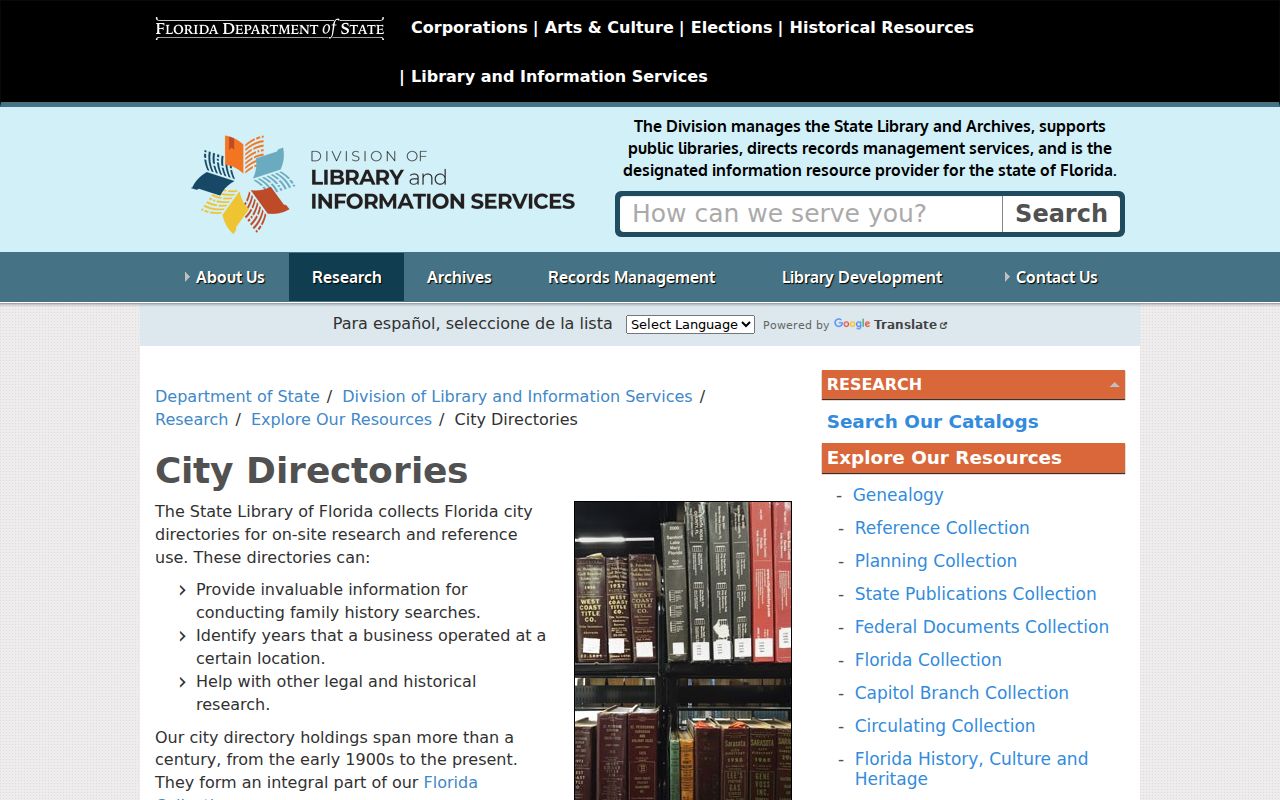
Use the catalog to identify a volume, then ask whether access is on-site and whether copying is allowed. A catalog result is not a downloadable resident list.
Sarasota Directory Archive Access
The History Center's Reference and Rare Books collection includes books, newspapers, yearbooks, and city directories. Its holdings exceed 570 archival collections, with nearly 10,000 digital items, mainly photographs. Some material is stored offsite. Staff ask for at least three business days to pull it, though no appointment is required at the temporary Osprey Library location.
Search the Sarasota County History Center catalog by person, street, business, school, and collection title. The view below helps identify a finding aid, but many directory volumes still need an on-site check.
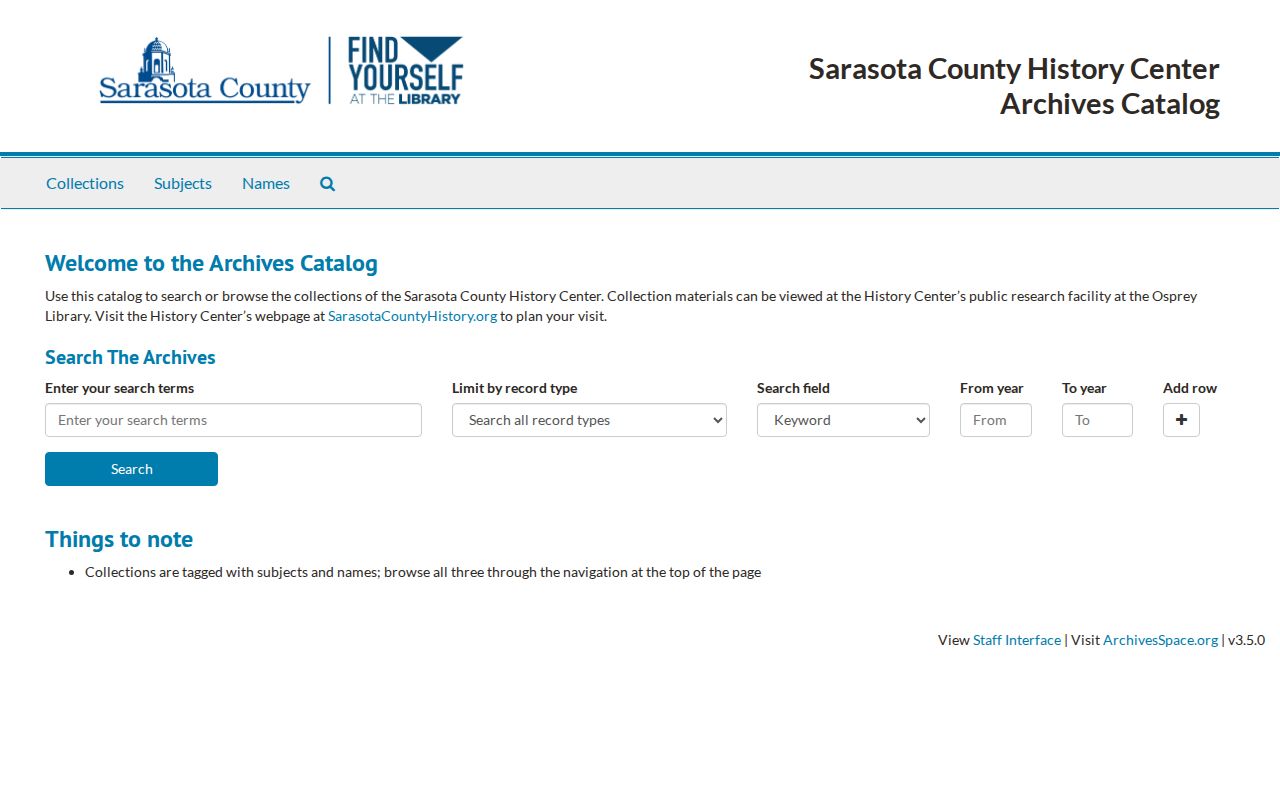
Send staff the exact year, surname, address, and related map or newspaper topic. A focused request gives staff enough detail to locate offsite items.
The temporary History Center is at Osprey Library, 337 N Tamiami Trail in Osprey. Its published contact channels are 941-861-6090 and historycenter@scgov.net. Hours are Monday through Friday from 10 a.m. to 5 p.m. and Saturday from 10 a.m. to 2 p.m. Some newspapers can be used online at the Center, while other material must be pulled for on-site review. An effective request names the repository item or directory title and asks whether the source is original, microfilm, digital, or offsite. That distinction determines what equipment, lead time, and citation details a visit will need.
Read Sarasota City Directory Entries
A Sarasota County city directory entry compresses several facts into one line. Read the volume's own key before expanding any code. Publisher conventions change. An alphabetical entry may name a spouse, occupation, employer or business tie, and residence. Vacancy and widow or widower notes can explain a change. A street section, when present, rearranges named entries by address.
| Name | Surname, given name or initials, sometimes with a spouse |
|---|---|
| Work | Occupation, employer, or public business link |
| Residence | House number, street, and publisher abbreviations |
| Status note | Vacancy or widow/widower notation when printed |
| Street entry | Occupant or business reordered by address when available |
- Criss-cross directory
- A section arranged by street or address instead of surname.
- Householder index
- A list centered on the named person tied to a household entry.
- Abbreviation key
- The publisher's legend for short job, place, and residence terms.
An entry records what the publisher gathered for that edition. It does not prove title ownership, list every adult, or show each rural household. Pair an occupant with deeds when ownership matters.
A Sarasota Directory Spelling Trap
An official historic narrative for 518 Adelia Avenue shows why consecutive volumes beat one hit. The 1926 directory places James E. Moore and wife Lottie there. In 1928, Donald McCarthy appears with Maurice and Maude McCarthy, and Maurice is tied to the Sarasota Times. The 1930 volume marks the house vacant.
Later entries expose an error. The 1936 directory prints Jonah C. and Carrie E. as “Cooper.” The 1938 volume uses “Cripper,” while 1940, 1945, and 1947 repeat Cripper. The 1945 entry links Mr. Cripper to a Main Street grocery. That series supports a print or index mistake in 1936, not a new family based on spelling alone. Search phonetic forms, initials, spouse names, occupations, and nearby years.
Manatee and Sarasota Directory Volumes
Sarasota's directory history crosses the county-formation line. Sarasota County did not exist before 1921, so a researcher may need Manatee-area labels even for a modern Sarasota County place. The National Archives directory inventory lists combined Bradenton, Manatee, Palmetto, and Sarasota volumes for 1921-22, 1927-29, and 1931.
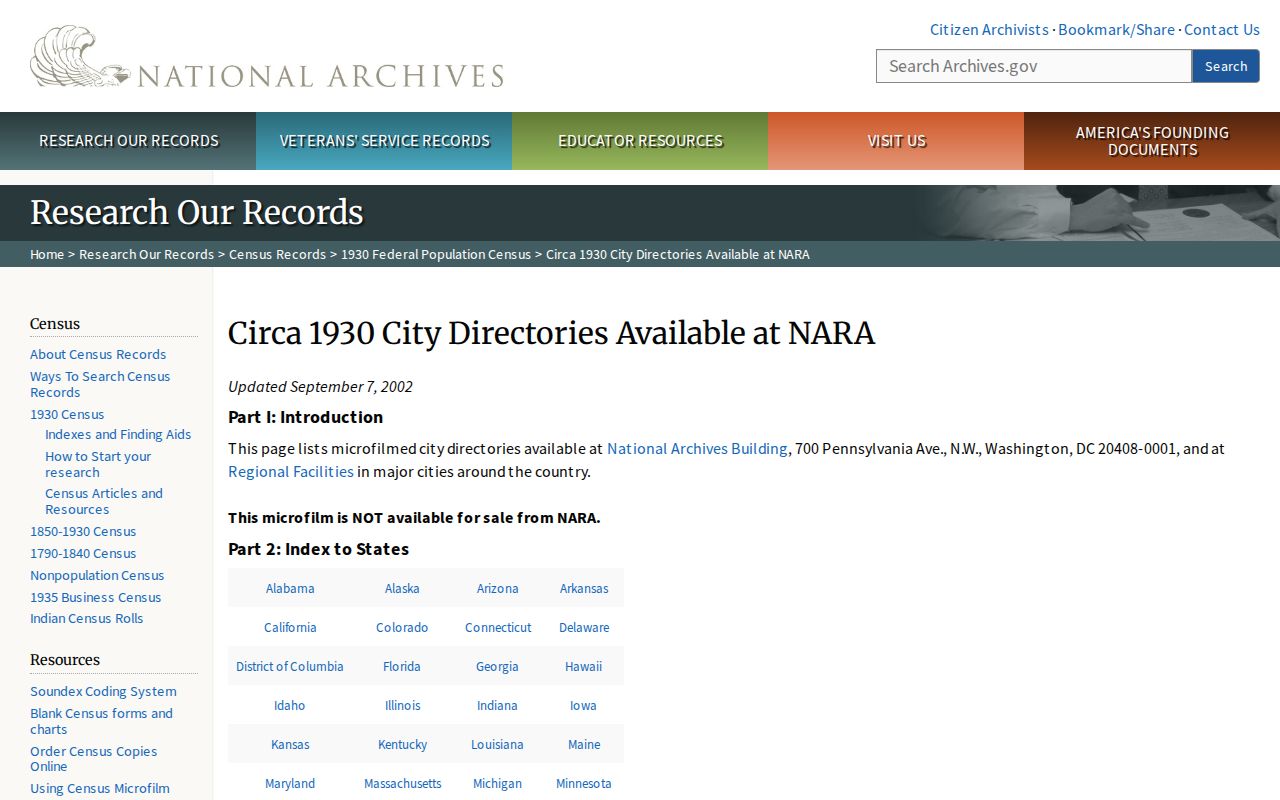
The inventory confirms an access route, not that each page is freely viewable online. Ask about the cited microfilm and use both Sarasota and Manatee terms in catalogs. Apply the same geography rule to pre-1921 deeds, probate, and court sources.
Trace Sarasota Families by Directory
Follow a household year by year, and keep each claim tied to its source date. City directories fill gaps between federal census years. The 1950 census is the newest public census under the 72-year rule, while directory entries may show intervening moves, occupations, spouse changes, and vacancies.
- Find the person alphabetically. Copy spelling, initials, spouse, job, address, and the edition's key.
- Check the street section, if present. Record other named adults or businesses at the address.
- Move to the prior and next available volumes. Mark arrival, departure, vacancy, or changed spelling without guessing why.
- Pair 1920, 1930, 1940, or 1950 entries with the census. The 1920 place was still in Manatee County.
- Use deeds for owners, probate after a disappearance, and permits or maps when a structure changed.
A missing entry may mean a move, death, omission, rural home, unlisted household, or collection gap. The Sarasota County resident lookup can help verify an identity after the historical trail reaches recent records.
Sarasota Records Beyond Directories
Sanborn maps give a house and block physical context. Official local work cites Sarasota sheets for 1913, June 1925, 1929, and 1940. They show footprints, materials, use, and nearby structures, not a complete resident list. Match a sheet by intersection and map index because old numbering can differ. Then join the building to the closest directory and census evidence.
Historical newspapers add life events, business notices, and address references. The History Center holds local titles dating into the 1880s. Search OCR with spelling variants, street names, and business terms. Yearbooks may give a full name, nickname, class year, club, and photograph, but an appearance does not prove graduation. Church and cemetery access depends on each keeper.
When a name vanishes from a directory, search the Sarasota Herald-Tribune and its predecessor titles, plus Venice Gondolier material for south-county leads. Save the publication title, issue date, page, and OCR spelling because result links can change. The county obituary service is another fallback when a notice is absent from the library's newspaper databases. Probate can explain an estate transfer, while an obituary may connect relatives and a prior address. Neither source should be used to smooth over a directory gap without a direct match.
Naturalization and military research need separate access checks. Before 1906, naturalization papers could be filed in several courts; later searches lean more on federal and National Archives catalogs. Recorded military discharge papers can be restricted. Fold3, federal service files, newspapers, and cemetery markers may provide lawful public alternatives. For church registers, ask about denomination, parish dates, record type, and restrictions rather than assuming the county library controls access.
Sarasota Directory Digital Companions
The History Center digital collection offers free searching across nearly 10,000 objects. Most are photographs rather than scanned city directory pages, yet images can confirm a building, street scene, business sign, or institution named in an entry.
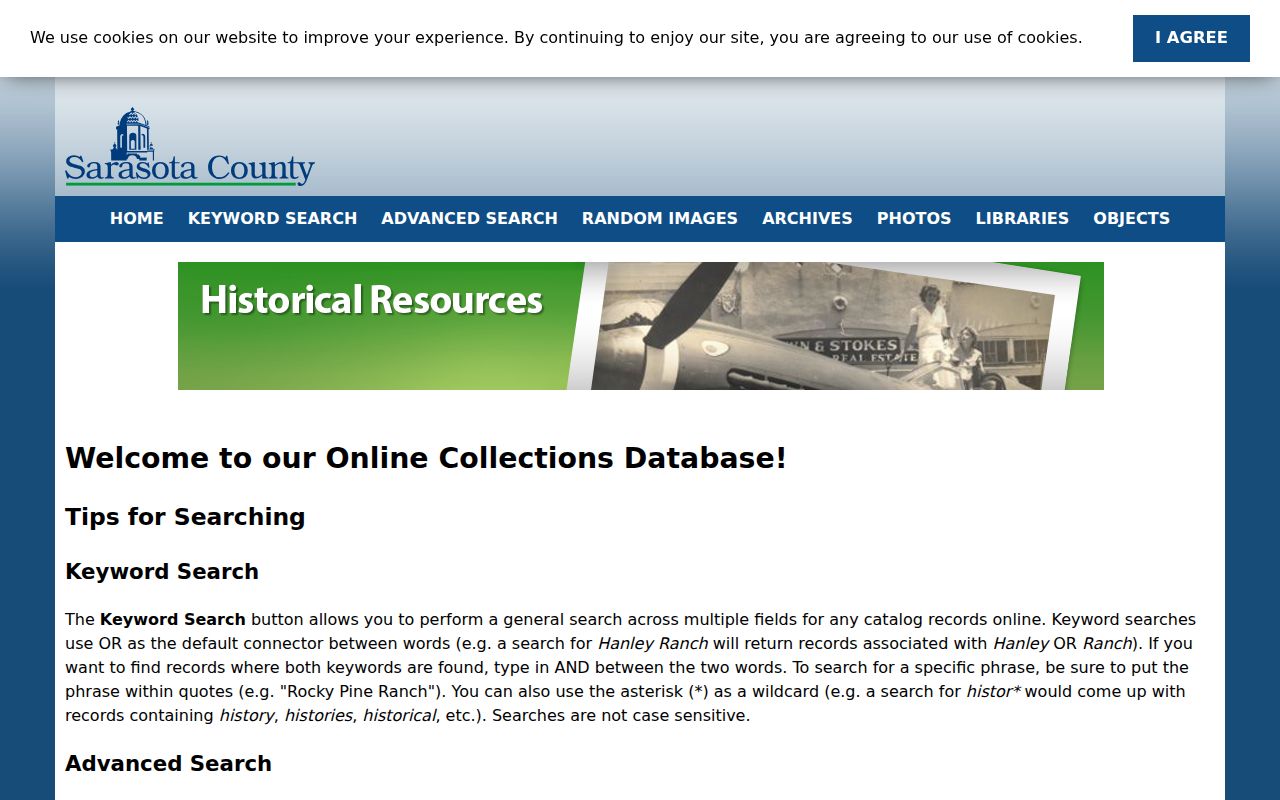
Use the result as context tied to a dated entry. Library channels include HeritageQuest, Fold3, FamilySearch affiliate access, and American Ancestors at Venice Library. Some need a card or in-library use, and affiliate access does not ensure every image can be downloaded.
Sarasota Directory Research Timeline
The local sequence explains which names and place labels belong in a search. It also prevents the web catalog from being mistaken for the full archive.
| 1918 | Earliest verified cited Polk Sarasota volume |
|---|---|
| 1921 | Sarasota County formed from southern Manatee County |
| 1921-31 | Combined Manatee-area directories appear in the federal inventory |
| 1977 | Sarasota County History Center established |
| 1999 | Latest year in the verified cited Polk sequence |
| 2025 | A gift funded large-format digitization and a public Memory Lab |
The new digitization work expands access, but it does not place every shelf volume online. Record the title, publisher, year, page, and repository for every finding so another researcher can reproduce it.